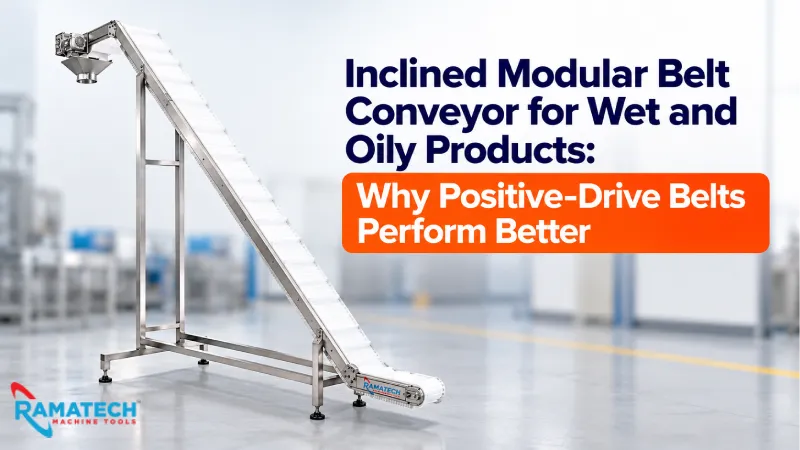
RAMATECH Machine Tools is a leading manufacturer of Inclined Modular Belt Conveyors for controlled product transfer in demanding industrial applications.
Wet, oily or contamination-prone products create a different conveying challenge from clean, dry packaged goods. When grip conditions change, a conventional friction-driven belt can become harder to manage. As an Inclined Modular Belt Conveyor Manufacturer in Ahmedabad, we use interlocking modular plastic belts with sprocket-driven movement for applications where dependable belt engagement, cleaning access and product stability are important.
Why Wet and Oily Products Change Conveyor Requirements
Moisture and oil can affect the contact conditions between a conveyor belt and its drive components. On an incline, the system also has to carry the product upward while controlling movement against gravity.
This makes belt selection especially important. The conveyor must control both the belt itself and the product travelling on it.
A modular conveyor approaches this differently from a conventional friction-drive arrangement. Its plastic modules engage with drive sprockets rather than depending only on friction between the belt and a drive pulley. Positive sprocket engagement helps prevent belt slippage and supports more consistent tracking.
What Positive Drive Actually Means
Positive drive refers to the mechanical engagement between the conveyor belt and its sprockets. Instead of relying on surface friction to pull the belt, sprocket teeth engage directly with the modular belt structure.
That distinction becomes especially important where moisture, oil, product residue, or regular washing can make operating conditions more demanding.
For buyers evaluating an Inclined Modular Belt Conveyor Manufacturer in Ahmedabad, the drive principle should therefore be considered alongside belt width, incline, speed and product type.
Positive Drive vs Friction Drive in Demanding Conditions
The differences are easier to understand when the two approaches are compared directly.
| Factor | Positive-drive modular belt | Conventional friction-driven belt |
|---|---|---|
| Drive method | Sprockets mechanically engage the belt | Drive depends on belt-to-pulley friction |
| Wet/oily conditions | Drive engagement is less dependent on surface friction | Reduced friction can affect drive behaviour |
| Belt tracking | Guided through sprocket engagement | Tracking depends more heavily on alignment and tension |
| Repair approach | Individual damaged modules can be replaced | Belt damage may require larger belt repair or replacement |
| Incline support | Cleats and sidewalls can be integrated | Depends on selected belt construction and attachments |
| Cleaning access | Modular construction can simplify access | Depends on belt and conveyor design |
Plastic modular belts are commonly valued for positive drive and tracking because sprocket engagement avoids the belt slippage associated with friction-based drive systems.
Why Inclined Applications Benefit From Modular Construction
An inclined conveyor has two simultaneous jobs: move the belt reliably and prevent the product from sliding backward.
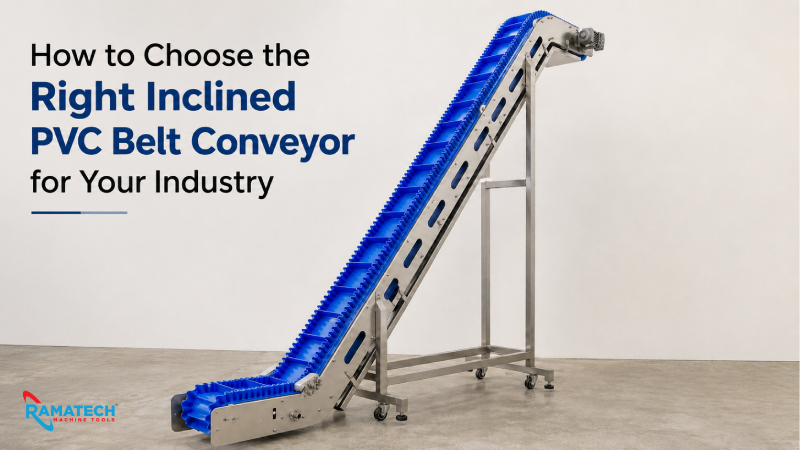
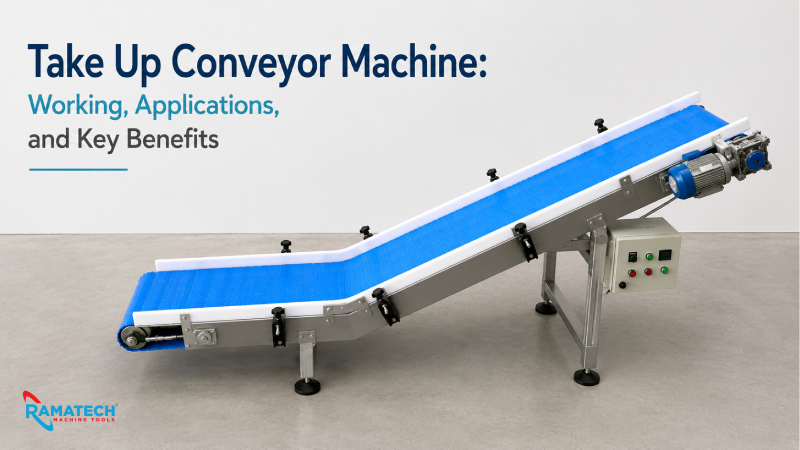
Our modular conveyor can be configured with integrated cleats and sidewalls to help control products while they travel upward. The machine supports an adjustable incline from 0° to 35°, depending on the required configuration.
Typical products that may be handled include:
- Cartons and crates
- Bottles and containers
- Pouches
- Blister packs
- Bulk goods
- Products requiring transfer between different working heights
The exact configuration should always be selected around the product's dimensions, weight, surface condition and required discharge height.
Why Modular Plastic Belts Suit Wet Environments
Modular plastic belts are made up of modules that fit together as opposed to being made of one single continuous belt. Modular plastic belts by RAMATECH Machine Tools include PP, PE, and POM materials, among other types of food grade plastics for the appropriate application.
The following are some of the advantages that come with this type of construction, particularly in situations where the environment is wet or the machinery needs to be frequently cleaned. In case there is any damage, only the damaged parts need to be replaced.
It should also be noted that the belt does not require high pre-tension in order to achieve sufficient drive friction.
Product Grip and Belt Drive Are Two Different Issues
The positive drive ensures the belt does not depend only on pulley friction; however, that does not imply that all products will grip the belt surface on an inclined angle.
This becomes important when deciding which conveyor type to use. Where there is the possibility of slippage, cleats, sidewalls, or even a suitable belt surface can be used.
A company like Intralox actually uses friction top modular surfaces precisely to ensure gripping of the product on an inclined or declined conveyor section.
This explains why our team looks at both aspects as distinct requirements.
Important Configuration Factors for Wet and Oily Products
Before selecting the conveyor, buyers should verify a few application details.
- Is the product itself wet or oily, or is the conveyor simply installed in a wash-down area?
- What are the dimensions and weight of the product?
- What incline angle and discharge height are required?
- Does the product need cleats or sidewalls to prevent rollback?
- Which belt material is appropriate for the application?
- What conveyor width and line speed are required?
- Is an SS 304 frame preferred for the working environment?
As an Inclined Modular Belt Conveyor Manufacturer in Ahmedabad, we use these inputs to configure the conveyor around the operating condition instead of treating every incline application as identical.
Available Conveyor Configuration
The RAMATECH Machine Tools Inclined Modular Conveyor can be customized based on production configuration. The system can be designed with a belt width ranging from 200 mm to 1000 mm, a belt length between 1.5 m and 10 m, an adjustable inclination angle from 0° to 35°, and a variable operating speed of 0 to 30 m/min controlled through a Variable Frequency Drive (VFD).
The material that can be used in constructing the frame includes SS 304 or mild steel with powder coating.
Where Positive Drive Makes the Biggest Difference
Positive-drive modular belts are particularly useful where operating conditions can make friction-based driving less predictable.
- Wet production areas: Water or frequent cleaning can change surface conditions around conventional belt systems.
- Oily product handling: Mechanical sprocket engagement reduces dependence on pulley friction for belt movement.
- Inclined transfer: Positive drive can be combined with cleats and sidewalls for controlled elevation.
- Continuous production: Replaceable modules can simplify repairs when a local section becomes damaged.
- Hygiene-conscious applications: Suitable modular materials and stainless-steel conveyor construction can support applications where cleaning access is important.
These advantages explain why modular conveyors are widely selected for challenging handling environments rather than only for simple horizontal transfer.
Why Choose Us
At RAMATECH Machine Tools, we offer inclined modular belt conveyors that are produced in relation to the actual product and plant layout. We have the capacity to customize the width of the belt, the length of the conveyor, incline, discharge height, construction of the frame, drive system, and product control. Our manufacturing facility is located in Ahmedabad. If you are a buyer looking for an Inclined Modular Belt Conveyor Manufacturer in Ahmedabad, our main aim is to design a conveyor that fits your product and environment.
Conclusion
The demands on an inclined conveyor increase in the case of wet and oily items as both the belt’s motion and the control over the item become increasingly important. Positive-drive modular belts solve the problem of drive by engaging sprocket wheels rather than relying on the belt’s motion through friction in the drive pulley. The cleats, sidewalls and the proper surface of the belt can be used to control the items. Customers can choose the conveyor according to their product’s state, angle, speed and configuration with RAMATECH Machine Tools. We are Inclined Modular Belt Conveyor Manufacturers in Ahmedabad.
Need an inclined conveyor for wet, oily, heavy-duty or difficult-to-handle products? Speak with RAMATECH Machine Tools about your product size, required incline, belt width, operating environment and line speed. As an Inclined Modular Belt Conveyor Manufacturer in Ahmedabad, we can help you select a suitable modular belt configuration for your production line.
Call +91 99799 96006 or email ramatechmachinetools@gmail.com today to discuss your requirement and request a quotation.